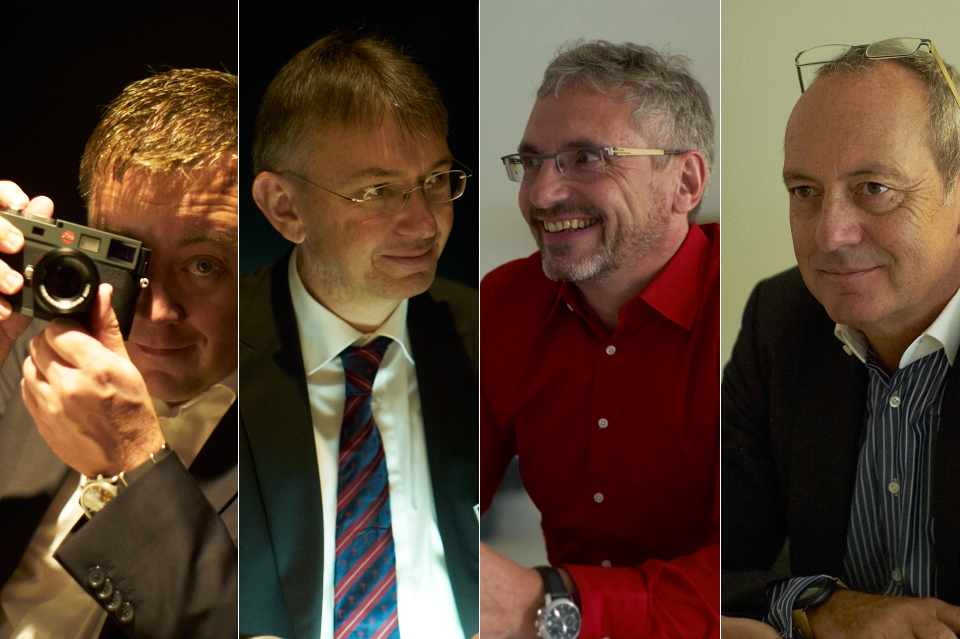

Peter Karbe, Head of Optical Design, Leica Camera AG Topics: the LEICA S

PY(Photo Yodobashi): Thank you for taking the time to talk to Photo Yodobashi today. (Showing rangefinder.yodobashi.com) This website covers all current M mount lenses from Leica and third parties, and some old lenses. Our concept is to shoot with the lenses and show the output to our customers. That's how it started.
PK(Peter Karbe): Actually, I personally am very much interested in M mount compatible lenses.
(This is a story from the interpreter)
Mr. Karbe is a collector of Leica-related publications. He liked the "Leica Tsuushin (report)" that Ei-Publishing Co. used to publish. He has some editions, but not all. I used to buy them all for him on the internet. (laughs) Some editions had premium price like 4000 yen for a book.
PY: Oh... (laughs)
PK: Japanese magazines, especially the old ones, cover so much information including lens diagram. They cover more than any German publications do.
PY: I see! (laughs) That's cool! (excited) Today we took a look at lens cutting process in the factory, and the guide said something very interesting. They use aspherical lenses in pursuit of tasty bokeh. It was completely new and surprising to me because I didn't think it was suitable for bokeh. I think aspherical lenses cause hard or ring bokeh. If I remember correctly, it's been quite a while since Leica started using aspherical lenses.
PK: We're the first to use the aspherical lenses.
PY: Right. You started from hand polishing. I'd like to ask how you use the aspherical lenses.
PK: Take the Noctilux for example, it has two aspherical lenses. Each of the two lenses has their roles. Simply put, they work to correct various aberrations wide open. As we showed you at the factory, aspherical lenses require complex shape glass cutting as well as simple polishing. Therefore, it's prone to have things like ripples. If the ripples are high, they cause hard and nisen bokeh. So, Leica has been very particular about the shape and smoothness of large aspherical lenses. And, this results in nice bokeh. For example, in Japan, bokeh by old lenses (ex. 35mm F1.4, the spherical Summilux) are highly admired. They say it produces sweet bokeh. Speaking of bokeh by old lenses, their spherical aberration isn't corrected properly. The term "bokeh" coincides with the improper performance and they say it's the taste of lenses. If we use aspherical lenses and correct various aberrations as much as possible, we can make an ideal lens which has a sharpness in the focused area and generates a complete blur in the defocused area. We use aspherical lenses having these thoughts in mind.
PY: I see. For example, the current Elmarit 28mm F2.8 is asphericalized, but the former generation was such an excellent lens. I wondered why it had to be asphericalized. And, the current one has much smaller barrel. Do you use aspherical lenses to downsize?
PK: Yes, there're some cases we use aspherical lenses to downsize. I guess it was 7 or 8 years ago. We have the 28mm F2, but the size is equal to the old 28mm F2.8. They are similar in terms of optics, but lenses become faster by one f-stop by using aspherical lenses. That's the point.
PY: I may be digressing, but M mount lenses by Carl Zeiss brand are all non-aspherical. How do you feel about their lens lineup?
PK: Traditionally, Leica has been focusing on making small but excellent lenses. In that sense, we were quick to try using the aspherical lenses. It's a basic cultural difference, I guess. Also, in the very early period of Leica's history, they started using difficult glass materials including glasses with large refractive index and soft, delicate large glasses. In that sense, I feel the difference of culture.
PY: I see. You're saying there's a clear conceptual difference.
PK: For the past few years, by installing floating mechanism into M mount lenses, we have been trying to maintain performance from minimum focus distance without changing the size of lenses. If we want to improve the performance from minimum focus distance, lenses tend to become larger. However, if we use the floating mechanism, we can even improve the performance without making larger lenses.
PY: I see. Let me ask about the current Summilux 35mm F1.4. Just like the former Elmarit, the former model was too great to be upgraded. However, after using it, I felt it was too great that I almost got petrified. The other day, I also used the new Summicron 50mm on the LEICA M Monochrom. To be honest, I think you've gone a little too far. (laughs). Anyway, depiction is magnificent and I have never seen anything like that. It's just hard to describe in words. It's very special and in another dimension. What is your intention of releasing a lens like this? Do you plan to do the same thing for other lenses?
PK: The APO Summicron M f2.0/50mm is a very special lens. It's not designed by what is wanted in the market, but we simply tried the best we can do by gathering every technology we have. We came up with this plan about 15 years ago, but in the film age, we didn't have the chance to utilize this high performance lens. Even in the digital age, we didn't think it makes much sense to use it on the color sensors. However, when one photodiode corresponds to one pixel like the LEICA M Monochrom, resolution simply becomes four times higher than conventional digital cameras. We could release this lens because we finally could release such a camera. So, as I always say it's like a Ferrari, we can never drive at the speed 300km per hour, but it shows it has the potential. Picture quality doesn't always directly link to resolution, but we put it aside and just pursued how far we can go.
PY: (being just amazed) Oh, I see. That's why it depicts immaturely.
PK: Is that so. (laughs)
PY: The former version of Summicron is a classic lens. It's very powerful, yet natural. I think it's more than good enough for general users. Performance was beyond description, or just like adding some extra points for insurance.
PK: I like it very much, too, but it's been 40 years since it was first designed.
PY: You're right. It's indeed very old.
PK: Still, it's widely used. I think it's because Leica has been making the lenses to be widely used since long ago. Or, I can say Leica has been making the best body according to the lenses, rather than making the best lenses according to the bodies like other brands did. Removing the lowpass filter is one example of optimizing the bodies for the existing lenses. Leica has been examining how the body should be in order to make the most of Leica lenses.
PY: So, it's a interchangeable body. (laughs) One last question. I feel Leica's ultra wide angle lenses render extremely well. Actually, I feel the same in any other focal length, but I'm especially impressed with the ultra wide angle lenses. Perspective is natural and there's no annoying deformation. It would be presumptuous to call it a secret, but what is it, if any?
PK: As for wide angle lenses, the M system itself is suitable for designing high performance wide angle lenses because of the short flange back distance. So, that is one secret, I can say. As our CEO Mr. Schopf said, it's evolution rather than revolution. We go step by step, so we don't do things drastically. Maybe it's because we're conservative. Yet, we have fast ultra wide angle lenses like this 21mm F1.4 and the 24mm F1.4, and we're providing a new way of taking pictures such as taking portraits with ultra wide angle lenses. So, I should say we strive to evolve steadily while sometimes we become innovative. They're the pair of wheels for our product development.
PY: I see. One more thing. When I first saw the pictures taken with the APO Summicron M f2.0/50mm, I was wondering what kind of person is designing and making it. And, today I'm glad I could know what you are like very well. (laughs) This is a personal question. Outside of your professional duty, do you have any particular lens you wish to make in the future?
PK: (Laughs) Now, I'm in the position where I can make what I wish to make, so in that sense, I may not have my dream lens. I make the current lenses in the market and I think they are my dream lenses.
PY: I know how well they perform, so you're absolutely right.
PK: I used to train myself as a photographer before I started working for Leica, but at that time I wasn't very happy with my pictures. I felt I didn't have a talent to become a photographer, so I came to Leica. What I found out after taking pictures with Leica lenses was that it wasn't the lack of my talent but the lack of performance of the equipment I was using at that time. (laughs) So, good Leica lens, or an ideal Leica lens provides so much information. If you look at the picture from a distance, it looks great. But, if you look it closely, you find so much information and you say "Yes! Yes!" That's what I call a good lens. There're many pictures that look good from a distance, but lack of detail when they're inspected closely. But, that's not what I want to make. I want to make lenses that capture so much information. The more closely you look, the more you find. That's the kind of lens I want to make as an engineer.
PY: I came here imagining it must be this kind of person who is making Leica lenses, and I'm happy because I was completely right. Thank you so much.
PK: (Laughs) OK, thank you.